Healing Earth Workshop 2026 at Ashoka
I recently got to attend the Healing Earth Workshop 2026 along with my colleagues Smayan and Naveen from FPLaunchpad.
As someone coming primarily from a computer science background, this was useful in understanding the domain knowledge that we need as part of the ESG (environment, social, and governance) applications research group in our lab.
Day 1
Day 1 was the workshop on the science of climate change.
Tiny Shells, Deep Time: How Marine Carbonates Record Earth’s Climate - by Prof. Sambuddha Mishra
The first talk was on Foraminifera (or forams) by Prof. Sambuddha Mishra. Forams are marine oragnisms with a Calcium Carbonate shell. These shells get deposited as sediment. Since evolving more than half a billion years ago, their shells -- and the corresponding sediments -- have also evolved due to the changing climate over these millions of years. In marine regions where the sediment has not been greatly disturbed (e.g. by an incoming river), a core sample can be studied to identify the historical climate conditions with our knowledge of the chemistry of Foraminifera shells of the time. This analysis tells us with some error range what the temperatures must have been like.
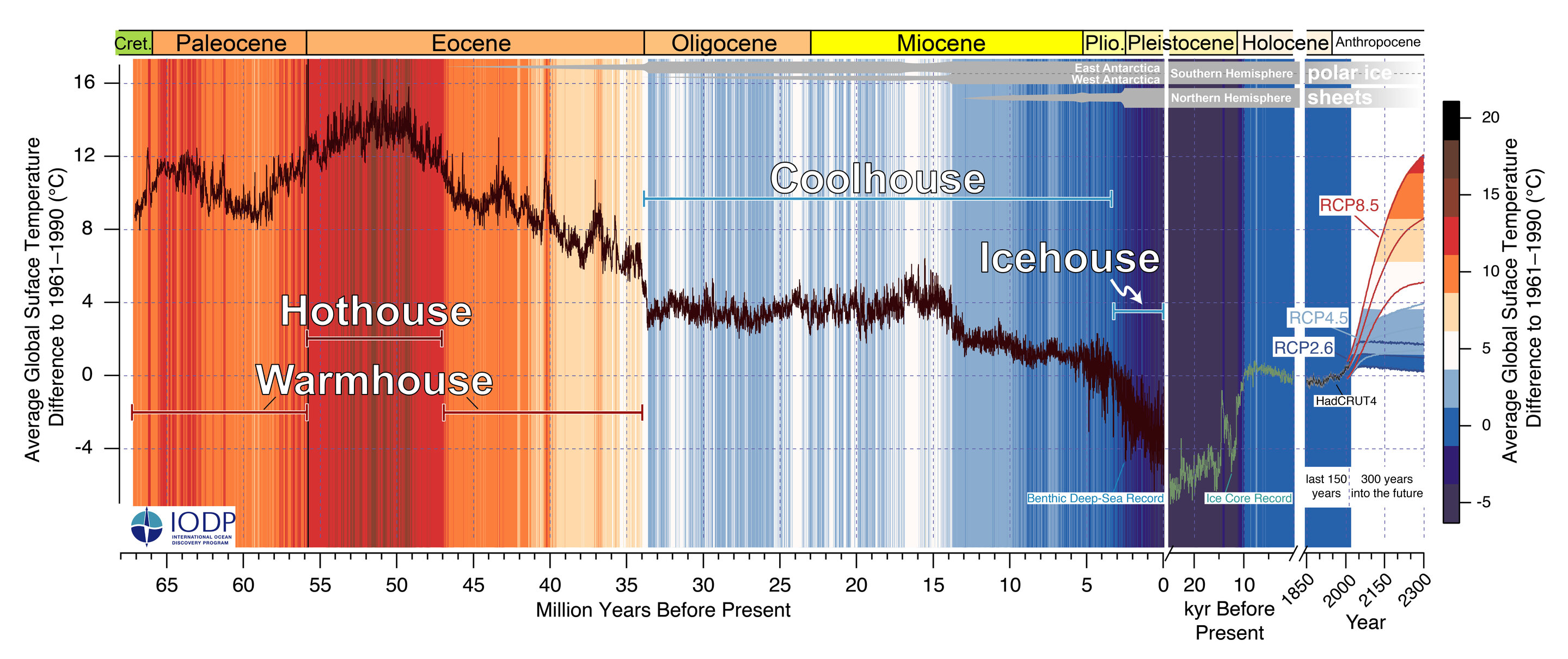
I learnt that temperatures were a lot hotter (by up to 16 degrees Celsius) about 50 million years ago, and we have since had colder and hotter periods. However, the rate at which the Earth has been warming since the industrial revolution is unprecedented. The slope of the temperature change from 10,000 years ago until 1850s is comparable to the slope of the temperature change since the industrial revolution until now (but increasing vs. decreasing).
How Mangroves Lock Away Carbon—and Why It Matters - by Prof. Indra Shekar Sen
Prof. Indra Shekar Sen spoke about the role mangroves play in storing carbon, the kinds of mangrove forests that exist, and the work needed to restore them.
Some important points he made:
- Since the industrial revolution, the burning of fossil fuels specifically has been the largest contributor for CO2 increase and rising temperatures.
- Soils hold thrice as much carbon as the atmosphere
- Permafrost -- frozen soil -- are special in that they hold ~~50% of organic soil despite only covering ~~15% of soil land. This is important because this organic matter has not been decomposed further only due to cold temperatures. If this warms -- and poles warm faster than the equator -- then microbes will get to act on this matter and release more CO2 as a byproduct of the decomposition, thereby contributing to global warming.
- Anoxia is a total oxygen depletion.
- In mangroves, under a very thin oxygenated surface, there is anoxia in the sediment. This means that carbon stored there will not get converted into CO2 by usual decomposition pathways.
- The carbon composition of mangroves is approximately:
- Above-ground: 10%
- Below-ground: 5%
- Soil sediment: 85%
- From a restoration angle, mangrove forests can be classified as degraded, restored, and old-mature.
- Old & mature mangroves are very good at locking carbon (through anoxia, as mentioned above)
- Degraded mangroves can be restored with human efforts but will take much effort and time (decades) to become as good as old & mature mangroves at carbon preservation
From intuition to technological solutions to environmental problems - by Prof. Meghna Agarwala
Prof. Meghna Agarwala spoke about examples of technological interventions to convey that we should understand the local context and nuances before intervening.
Her first case study was of pine trees in Himachal and Nepal. Historical records indicate that pine was not native to the altitudes they studied (300m-3,000m). These plantations were done around 1970s and after as part of the national policy on climate change intervention. This however has had bad consequences for the local ecosystems because:
- grazing lands were converted to pine-forest lands, impacting existing local livelihoods
- pine trees are more susceptible to fires
- natural regeneration was better in some areas and reached 99-100% cover
She further adds that increasing canopy height or canopy cover would not be useful in most areas in India because most of our forests are savannas / open natural ecosystems. We should not purely chase plantation cover but look at the local ecology and livelihoods.
Another consequence she adds is the human-wildlife conflict introduced when nuance is not understood. She gave the examples of elephants -- who prefer low-canopy forests. In Odisha, there are roughly 200 human deaths and 50 elephant deaths in a year.
Carbon, Commodity, Community: the Science and Practice of Nature-based Solutions - by Prof. Ghazala Shahabuddin
Prof. Ghazala speaks about nature-based solutions (NBS). A central point was that higher biodiversity -- the species richness -- tends to have higher carbon sequestration as well. She criticised the transactional, itemised carbon trading systems that ignore the local biodiversity and ecology.
She gave an example of a study that estimated the metric tons of CO2 that can be removed by eliminating Lianas -- long-stemmed vines -- from trees in a forest. This is disturbing because it takes away from the local diversity.
Another example she gave was of Gujarat where Google purchased carbon credits to remove 100,000 tonnes from a firm called Varaha. The vendor's pathway for that was to remove trees of an invasive species (Prosopis juliflora), convert them into biochar, and bury that biochar under the soil. The hypothesis is that under the soil, this biochar will store carbon for centuries. One unintended consequence of this has been that because biochar retains soil moisture, this benefits the same invasive Prosopis tree over native grass.
I found this article that speaks of the same issue.
I liked her warning about measuring climate change and mitigation through a single and incomplete metric such as carbon score, but to understand the long-term benefits and harms of our actions. Ecosystems are more complex than a single metric can capture; and destroying ecology in one region cannot often be compensated by actions in other regions, especially without understanding the regional ecologies.
Climate change & infectious disease modelling - by Prof. Gautam Menon
Prof. Gautam spoke about climate change as a public health risk directly because the survival and transmission of many pathogens is also dependent on the climatic conditions.
For example, malaria has a certain temperature range under which it survives, and a temperature at which it is optimal. The relationship between transmission and temperature for malaria is modelled by the Briere equation. This graph has a gradual build-up till optimal and then a steep fall.
He also spoke about STH - soil-transmitted helminths - as neglected tropical diseases. About 1 billion people are susceptible to this.
More participation, less AI: Lessons from the CoRE stack - by Prof. Aaditeshwar Seth
We at FPL are collaborating with Prof. Aaditeshwar Seth's initiative for applying computer science knowledge to social problems. He was super kind to us, and generous with his time during the breaks where we got to introduce each other and discuss about the projects we could work on.
In this talk, he spoke about their bottom-up methodology they use in CoRE-stack. I have also been thinking about PDGI and PDI, and CoRE-stack's work is an important case study. Some important points from his talk:
- community-based problem discovery:
- this is important to do - but I also imagine difficult to operationalize. I think their landscape stewards and interactions with local communities play a major part in this.
- active in >2,000 villages
- disconnect in individual good vs collective good
- disconnect between top-down vs bottom-up decision making
- for example with government initiatives, planning is done at the top and implementation is expected to be identical everywhere
- this misses local complexities
- a better model is when there can be guidance from the top, and local communities can be empowered to plan on their own
- communities should to be empowered to make decisions at their level
- there may be power-based inequalities such as with local elite groups that capture resources and schemes
- we should build a model where local knowledge and domain-expertise can be used to make better decisions
- the Commons Connect app can be used to explore geospatial datasets and relevant geotagged data
- then add local knowledge
- produce DPRs - Detailed Project Reports
- then this DPR can be submitted at Gram Sabha, and then Gram Panchayat
Day 2
Day 2 was the workshop on the policy of climate change.
We need to operationalize climate change mitigation strategies through policies that interact with people's livelihoods, industries, and urban-rural planning. This needs to be planned through. I also learnt that the discourse will have to be different in the global north and in the global south, and to understand such biases when reading literature. This, formalising solutions to the problem of how we deal with climate change in our context -- local culture, livelihoods, inequalities -- is most interesting.
The climate change crisis: How should India respond? - by R.R. Rashmi
R.R. Rashmi was part of India's team under the UN's climate change conversations around the time of the Paris Agreement. He gave important insights into India's interests and where it conflicts with western narratives and policy. He mentioned that there is a tendency to look only at current emissions when assigning blame and responsibility, rather than looking at the historical emissions that led us here. This is unfair to developing and non-western countries such as India that industrialised later. This was a new perspective for me and I agree.
The international progress towards the goal is very bad (only 5.6% of the 43% target).
For phasing out fossil fuels, India and China resisted cutting coal's share to 0-2% because it will not be replacable with current technologies. Europe has already peaked, unlike developing countries such as India, so they can push to phase out fuels such as coal.
India is one of the few countries where forests are a net sink, not a net emitter -- unlike Brazil, Indonesia, Congo.
Power sector is responsible for the highest (40%) emissions. To replace fossil fuel with renewable sources of energy, we need infrastructure for energy storage.
I learnt about a couple of initiatives:
- CBAM: Carbon Border Adjustment Mechanism is the EU's mechanism to price carbon emissions from imported goods. Similar to carbon tax I think.
- CDM: Clean Development Mechanism was defined in the Kyoto Protocol as a way for developed countries to invest in carbon emission reduction efforts in developing countries to gain carbon credits.
Under the Kyoto Protocol of 1992, there was something called CBDR (Common but Different Responsibilities), under which more responsibility would fall on the developed/industrialised countries than on developing countries to mitigate climate change. This changed under the Paris Agreement, where the new model was Nationally Determined Contributions (NDCs).
A reflection on the law and policy of India on addressing climate change through Urban Governance - by Prof. Uday Shankar
Prof. Uday spoke about urban spaces as the biggest emitters, and hence also where responsibility must be taken. He emphasized the role that local urban governing bodies can have when they are given the resources and implementation autonomy to meet their responsibilities.
Some of his points reminded me of Prof. Aadi's and Prof. Meghana's talks from day 1 -- where they warn about top-down policy implementation without understanding local complexities and local ecologies. That, but centered around urban governance.
We should build capacity and city cadre so that there can be responsibility and ownership at the level of the city.
For keeping officebearers accountable, he believes the public opinion should be reflected in the electoral process. He also mentioned that the right to recall exists for some municipalities but is not popularly exercised.
Cities and Climate Change: the shifting dialectics - by Prof. Sumedha Basu
This was another talk that looked at climate change under an urban planning context. I liked this talk because Prof. Sumedha highlighted the complexities within cities -- e.g. air-conditioned malls and tin-roof slums -- and we should be mindful of these when we think of climate change in an urban setting.
Cities are the worst emitters, but are simultaneously the most vulnerable sites. They consume disproportionate amounts of energy - 70% of global GHG emissions. More people are expected to migrate to cities in the coming years. She mentions that we will need 144 million new homes by 2070. This infrastructure is important. Settlements are long term: houses built without planning for unexpected climate events will be challenged.
She mentions the complexity and vulnerability in urban spaces. She showed thermal images of some areas in Pune that they had studied. The more organised settlements (made from cement, conrete) were much cooler than the unorganised tin-roofed settlements that captured more heat.
Along a similar line as what Prof. Uday mentioned in the previous talk, she mentions that urban governance bodies can be proactive about carrying out their responsibility. She gave the example of Surat.